

“Amilyar” or Real Property Tax (RPT) in the Philippines is a tax that owners of real property need to pay every year. If you don’t pay, the local government unit (LGU) can include your property in their next tax delinquent properties auction. Details below.
Table of Contents

Amilyar Meaning And Etymology
“Amilyar” comes from the Tagalog word amilyaramyento which means “buwis sa lupa” or property tax. Amilyaramyento was borrowed from the Spanish term amillaramiento meaning tax assessment or register of assessed assets. Introduced during the Spanish colonial period, amilyar remains important today because non-payment can lead to penalties, interest, and foreclosure.
The legal basis for amilyar is inside Title II of the Local Government Code (Republic Act No. 7160). This annual tax accrues on January 1st, and it is a superior* lien which means it takes precedence over other liens, mortgage, or encumbrance of any kind whatsoever, and shall be extinguished only upon payment of the delinquent tax.
*Note: I believe this is the reason why banks/Pag-IBIG require housing loan borrowers to submit receipts as proof of payment for amilyar/RPT every year. More on this below.
The implementing rules and regulations of R. A. 7160 can be found here.
If you have prior years’ delinquencies, interests, and penalties, your RPT payment shall first be applied to them. Once they are settled, your tax payment may be credited for the current period.
Here’s a video that discusses amilyar:
Importance of Amilyar or Real Property Tax (RPT)
As a homeowner, You would not want your property to end up in a tax delinquent property auction right?
Which is why you should pay for amilyar/ Real property tax or RPT.
More about tax delinquent property auctions below.
Tax delinquent property auctions
Non-payment can actually lead to an investment opportunity where real estate investors buy tax-delinquent real properties by participating in auctions held by LGU’s.
Tax foreclosure auctions are held by virtue of sections 260 and 263 of RA 7160 otherwise known as the Local Government Code of 1991.
Buying tax delinquent properties is one of the many ways one can buy properties at low prices.
We also publish schedules and lists of tax-delinquent real properties of different cities – they are classified under the category tax-delinquent properties.
In the past, we have discussed what happens during these LGU auctions. You may want to read them should you be interested in this type of investment:
- Marikina Public Auction of Tax-Delinquent Real Properties (one of our very first posts)
- Four tips for investors who plan to invest in tax-delinquent real properties in Quezon City
- 9 lessons learned from the real property tax foreclosure auction sale in Quezon City
Who should pay Amilyar / Real Property Taxes?
The owner or administrator of the property should pay for amilyar / real propert tax.
We often get this question:
“Hi Jay/Cherry, should I pay amilyar/RPT even if my property is not yet fully paid?”
Yes, even if a property is not yet fully paid (you either bought through installment or through a real estate mortgage loan and you still have an unpaid balance), you already have to pay.
Sometimes, landlords will require their tenants to pay for the amilyar/RPT. If you are renting a property, better check your lease contract to be sure.
Want to get notified when this is updated? Subscribe for free updates!
Get new/updated foreclosed listings, auction schedules, property buying tips, and more, sent straight to your email inbox. It's free!
Where to pay
To pay for amilyar/ RPT, simply go to the City or municipal treasurer’s office where your property is located.
When to pay
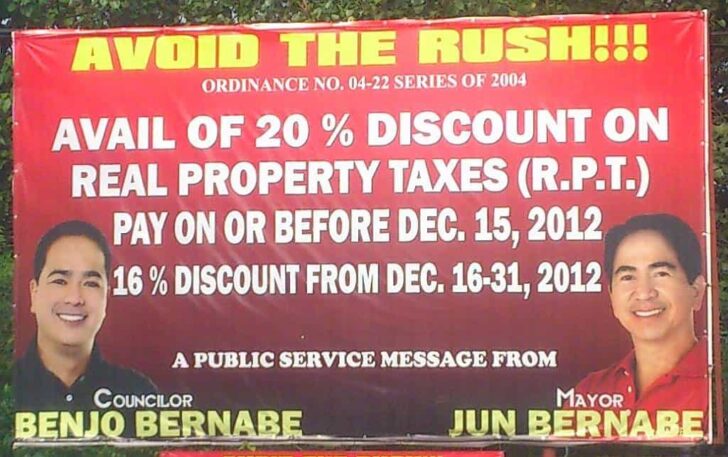
If you choose to pay for one whole year, the payment is due on or before January 31. If the basic RPT and the additional tax accruing to the Special Education Fund (SEF) are paid in advance, the sanggunian concerned may grant a discount not exceeding twenty percent (20%) of the annual tax due. Jay wrote about the discount on RPT recently in his post How To Get A 20% Discount on Real Property Taxes.
If you choose to pay in installments, the four quarterly installments shall be due on or before the last day of each quarter, namely: March 31, June 30, September 30, and December 31.
In case of failure to pay the basic RPT and other taxes when due, the interest at the rate of two percent (2%) per month shall be imposed on the unpaid amount, until fully paid. The maximum number of months is thirty-six (36) months, so effectively, the maximum interest rate is seventy-two percent (72%).
What to bring when paying amilyar
You need to present a copy of your tax declarations. Make sure to bring the tax declarations for land and or improvements as applicable to your property.
How to compute for amilyar or real property tax (RPT)?
Here’s a formula for RPT:
|
RPT = RPT Rate x Assessed Value |
Here’s a sample computation
Data:
Actual use of property: Residential
Location: City within Metro Manila
FMV per assessor’s officer (based on Tax Declaration):
Land – P350,000
Improvement – P350,000
Assessment Level for Land: 20%
Assessment Level for Improvement: 20%
Note: The assessment levels are fixed through ordinances of the Sangguniang Panlalawigan, Sangguniang Panglungsod, or the Sangguniang Pambayan of the municipality within the Metro Manila area. We will be using the maximum rates for sample computation purposes.
Computation:
Assessed Value of Land = P350,000 x 20% = P70,000
Assessed Value of Improvement = P350,000 x 20% = P70,000
Basic Real Property Tax for Land and Improvement
= (P70,000 + P70,000) x 2% = P2,800
Special Education Fund (SEF) for Land and Improvement = (P70,000 + P70,000) x 1% = P1,400
If you simply want to know how much is your amilyar, just get a statement of account or SOA at the City or municipal treasurer’s office.
What are the RPT rates?
Maximum RPT rates
|
Coverage |
RPT rate |
| Cities and Municipalities within Metro Manila |
2% |
| Provinces |
1% |
How to compute for Special Education Fund (SEF)
In addition to the basic RPT, the LGU’s may levy and collect an annual tax of one percent (1%) of the assessed value, which shall accrued exclusively to the Special Education Fund (SEF).
How to compute Assessed Value in the Philippines?
Assessed value is basically the property’s fair market value multiplied by its assessment level.
|
Assessed Value = Fair Market Value x Assessment Level |
What is Fair Market Value?
Sec. 199 (l) of the LGC defines “Fair Market Value” as the price at which a property may be sold by a seller who is not compelled to sell and bought by a buyer who is not compelled to buy. In practice, however, the Fair Market Value is based on the assessment of the municipal or city assessor as written in the Real Property Tax Declaration (Land and Improvement).
What is assessment level?
The Assessment Level shall be fixed through ordinances of the Sangguniang Panlalawigan, Sangguniang Panglungsod, or the Sangguniang Pambayan of the municipality within the Metro Manila area.
To get this data, look for the tax Ordinance of the city or municipality where your property is located.
Maximum Assessment Level Rates
The following are maximum rates for the assessment levels of different types of real property in the Philippines
I. Land
|
Class |
Assessment Level |
| Residential |
20% |
| Timberland |
20% |
| Agricultural |
40% |
| Commercial |
50% |
| Industrial |
50% |
| Mineral |
50% |
II. Building and Other Structures
- Residential
|
FMV Over |
But Not Over |
Assessment Level |
|
0.00 |
175,000.00 |
0% |
|
175,000.00 |
300,000.00 |
10% |
|
300,000.00 |
500,000.00 |
20% |
|
500,000.00 |
750,000.00 |
25% |
|
750,000.00 |
1,000,000.00 |
30% |
|
1,000,000.00 |
2,000,000.00 |
35% |
|
2,000,000.00 |
5,000,000.00 |
40% |
|
5,000,000.00 |
10,000,000.00 |
50% |
|
10,000,000.00 |
60% |
–
2. Agricultural
|
FMV Over |
But Not Over |
Assessment Level |
|
300,000.00 |
25% | |
|
300,000.00 |
500,000.00 |
30% |
|
500,000.00 |
750,000.00 |
35% |
|
750,000.00 |
1,000,000.00 |
40% |
|
1,000,000.00 |
2,000,000.00 |
45% |
|
2,000,000.00 |
50% |
–
3. Commercial/Industrial
|
FMV Over |
But Not Over |
Assessment Level |
|
300,000.00 |
30% | |
|
300,000.00 |
500,000.00 |
35% |
|
500,000.00 |
750,000.00 |
40% |
|
750,000.00 |
1,000,000.00 |
50% |
|
1,000,000.00 |
2,000,000.00 |
60% |
|
2,000,000.00 |
5,000,000.00 |
70% |
|
5,000,000.00 |
10,000,000.00 |
75% |
|
10,000,000.00 |
80% |
–
4. Timberland
|
FMV Over |
But Not Over |
Assessment Level |
|
300,000.00 |
45% | |
|
300,000.00 |
500,000.00 |
50% |
|
500,000.00 |
750,000.00 |
55% |
|
750,000.00 |
1,000,000.00 |
60% |
|
1,000,000.00 |
2,000,000.00 |
65% |
|
2,000,000.00 |
70% |
–
II. Machineries
|
Class |
Assessment Level |
| Agricultural |
40% |
| Residential |
50% |
| Commercial |
80% |
| Industrial |
80% |
Special Classes of Real Property
All lands, buildings, and other improvements thereon actually, directly and exclusively used for hospitals, cultural, or scientific purposes, and those owned and used by local water districts, and government-owned or controlled corporations rendering essential public services in the supply and distribution of water and/or generation and transmission of electric power
What are the assessment levels for special classes of real property?
|
Actual Use |
Assessment Level |
| Cultural |
15% |
| Scientific |
15% |
| Hospital |
15% |
| Local water districts |
10% |
| Government-owned or controlled corporations engaged in the supply and distribution of water and/or generation and transmission of electric power |
10% |
What is Ad Valorem Tax on Idle Lands?
In addition to the basic RPT, the LGU’s may collect ad valorem tax on idle lands.
The maximum idle lands tax is 5% of the assessed value of the property.
What are Idle Lands?
1. Agricultural lands more than one (1) hectare in area, suitable for cultivation, dairying, inland fishery, and other agricultural uses, ½ of which remain uncultivated or unimproved.
- Exceptions
i. Lands planted to permanent or perennial crops with at least 50 trees to a hectare; and
ii. Lands used for grazing purposes (Note: put goats or cows on your property).
2. Lands Other than Agricultural, located in a city or municipality, more than 1,000 sqm. in area, ½ of which remain unutilized or unimproved
3. Residential lots in subdivisions, regardless of land area
Frequently Asked Questions about Amilyar/RPT
Q: What is the deadline for property tax payment in the Philippines?
A: The deadline for the payment of real property tax is typically by the end of the first quarter of each year. It may vary slightly depending on the guidelines set by the LGU. Late charges and penalties may be applied if you miss the deadline.
Q: How do I pay my real property tax?
A: The payment process is simple. You can pay real property tax at a physical payment center such as your city hall or proceed to your LGU’s online payment portals, if available. You will need to present your latest real property tax receipt and if you are a new owner, you will also need a copy of your property title.
Q: Do I need to declare my real property?
A: Yes, as a property owner, it is your duty to make a declaration of real property for taxation purposes. It is the basis for the assessment of the property for taxation purposes under the Real Property Tax Code.
Q: Are there any discounts or exemptions for property tax?
A: Yes, there are specific tax exemptions provided by the local government code. These may include, but not limited to, farms, fish ponds, and charitable institutions. Also, you can avail of discounts if you pay early.
Q: What happens if I have already paid my real property tax but lost my official receipt?
A: If you have already paid your property tax but lost the official receipt, you can request a duplicate from the city government office. The city hall can verify the payment based on their records and issue a replacement receipt.
Note: As mentioned above, banks/Pag-IBIG require housing loan borrowers to submit receipts as proof of payment for amilyar/RPT every year.
Q: Can a real estate broker help with paying property taxes?
A: Yes, a real estate broker can assist you in paying your real property taxes. They are very familiar with the process and can guide you through the necessary steps, required documents to bring, and making the actual payment.
~~~
Do you have any questions, comments or reactions? Just let me know by leaving a comment below, thanks!
~~~
Cherry Vi M. Saldua-Castillo
Real Estate Broker, Lawyer, and CPA
PRC Real Estate Broker License No. 3187
PRC CPA License No. 0102054
Roll of Attorneys No. 55239
Text by Jay Castillo and Cherry Castillo. Copyright © 2008 – 2024 All rights reserved.
Full disclosure: Nothing to disclose.
Image courtesy: of renjith krishnan / FreeDigitalPhotos














ano po ba ang requirements sa pag bayad ng amilyar? kasi po dating old house po namin magkakapatid na lima ay pinagawa po ng bagong house para sa aming lima na tig isa na kming unit. paano po kmi magbayad ngayon. kasi bago na po. salamat po..
Hi Ramon, separate na ba mga titulo nung limang unit? If separate na, dapat hiwalay na din mga tax declaration. Kailangan niyo lkang magdala ng copy ng tax declaration sa City Treasurer’s office para magbayad ng amilyar.
If hindi pa separate angh mga titulo, amilyar ng buong property ang babayaran niyo, tapos maghati na lang kayo sa gastos.
Do i need to pay property tax even if my house is still under pagibig housing loan and no title yet under my name? Only the title that pagibig fund issued me which is still under their name.
Yes, as the owner who actually uses the property, you have to pay RPT even if the property is still under the name of Pag-IBIG.
Hello,
We plan to buy a property on GSIS foreclosed property. One of the requirements is RPT for this year. We went to LGU and found out the previous owner from 1991-2011 did not pay any taxes. Now we can’t get a RPT, because they want us to pay the unpaid taxes from 1991-2011. GSIS said they can’t do anything about it since they don’t deal with taxes? What can we do to get the RPT without having to pay the unpaid taxes from 1991-2011. Thank you
Hi Jaynuda, if that is the standard practice of GSIS, I’m afraid there’s nothing much you can do. You really have to pay the RPT, sorry. However, what I have done before for similar instances was to negotiate to waive any penalties/interest/surcharges to lower the cost (although this was often for the HOA/Condo dues, not RPT… luckily, RPT was shouldered by the banks for all the foreclosed properties we have purchased so far). Maybe you can do the same for the RPT, just go to the treasurer’s office to ask if they can waive penalties/surcharges/interest.
Hi, I bought a condo through bank financing back in 2018. I’m paying my monthly loan and monthly association dues accordingly. However, it has come to my attention that I haven’t paid any taxes(as far as I’m aware of) other than the 2 dues I have previously mentioned.
With that in mind, I want to ask if my condo(which is still under bank financing until 2038), is subjected for a RPT? Because I have read somewhere(I can’t remember where) that when you take a home loan, since you are investing in property in exchange for money, the loan can be exempted from taxes. Is this true?
Because I’m afraid that since I haven’t been paying any RPT for the past 4 years, I’m subjected to huge penalties and that could really mess things up for me.
Your advise regarding this matter is much appreciated.
Hi Kifen, you might be referring to the principal residence tax exemption for capital gains tax. However, for real property taxes (amilyar) I have never heard of any exemption just because you have a loan (pwedeng exempted kung government properties, owned by religious/charitable/educational institutions, used water/electricity utilities , property owned by cooperatives, etc).
In your case, the RPT might be included in the monthly association dues, and the condo corporation is paying the RPT for you.
To check, better get a statement of account at the city treasurer’s office at the city hall/municipal hall of the city/municipality where your condo is located. You should bring a copy of your tax declaration. If you don’t have a copy, just tell them your unit’s address and they can look for the tax dec, and then you can ask for a statement of account.
Hi, a question on RPT. My condominium admin is charging a separate RPT fee for “Common Areas” (hallways, lobby, amenities, etc). From google search, I read that such yearly tax due is normally covered already by the monthly association dues. I have other condo properties w/in the Municipality where the admin head told me that yearly tax for common areas is already covered by our assoc dues. But in this one property it’s different. I am charged P7.7k annually for common areas! Is this legal? My assoc dues rate across properties on the same municipality is basically the same at P97/sqm (as of this writing). Amenities across these properties are the same as well (pool, gym, elevators, etc, nothing special). Any input/s is much appreciated. TIA!
Hi Victor, it depends on the condo if the dues are inclusive of RPT, although if it is not inclusive, the dues should be smaller. Better get an itemized breakdown of the Php97/sqm or ask them to explain why the dues are still that high even if RPT is not included. Does it include expenses that cost more? (ex. higher insurance premiums, other maintenance costs, etc).
Please help!!! I found an agricultural Farm Lot offered for sell. The area shown in the Tax Declaration was 6 has. w/ the ff: Tax assessment : Market Value Php 957,600.00. Assessment Level 10, Assessed Value PHP 97,760.00, Assessor’s Findings, CORNLAND=1.500, MV=153,000.00, COFFELAND=1.00, MV=120,000.00, SUGARLAND=3.500, MV=524,000.00, a total of 6 hectare.Upon further research, the V-37 from the DENR showed that the Lot contains only 37,125 sq. m. or 3.7125 has. only. It has a tax delinquency based on the 6 has which was not the actual area of the farm lot. My question is; Do I have to pay the tax delinquency of the mis-declared 6 has. or I will pay the delinquent taxes on the actual area of 3.7125 has. of the farm lot. Thank You Very Much.
Hi Albert, let me answer on behalf of my wife Cherry. I believe you should insist that you’ll only pay the delinquent taxes for the actual area of 3.7125 has, much the same way they insist that taxes must be paid for a property’s actual area that includes any that are undeclared, if any (in other word, it should work both ways).
Ask lang po. pwede na po bang bayaran ang amilyar NG bahay kahit wala pang titulo ang lupa?
Hi, good afternoon. Ask ko lang pano po malalaman kung updated yung amilyar? May binili kasi kaming lupa 300sqm pero naka mother title pa sia. Notarized deed of absolute sale pa lang hawak ko tska yung xerox ng title. Ano pa po kaya pede ko malaman about sa mga taxes?
Tanong ko lng po kung makatarungan po ba na mag issue ng notice of realty tax delinquency after 11 years kung saan lumaki nga lumaki ang penalty at interest lalo na po at wala kami idea na yung bahay namin na bungalow, as per municipal assesor, na may yearly payables kami when it comes to RPT…hindi po ba dapat yearly po kasi according po sa batas, dapat immediately po yung issuance ng notice of delinquency?
Kung meron akong isang residential land sa probinsya at meron itong fair market value below 175,000 php, does it mean na exempted ito sa yearly real property tax since ang assessment level is 0%?
Hello my nabili po akong Land sa Probinsya part ng Mindanao 1 hectare cost 80k php. Magkano po kaya mababayaran ko sa BIR Bali agricultural po siya?
need to ask at medjo malaki po siningil sa akin para sa bayad sa BIR paano po ba kino compute ?
salamat
Hi po Sir,
Meron lang po ako concern sa tinitirahan naming lupa, actually yung lupa po ay sa lolo ko dati pero isinangla and di na daw nabayaran kaya napunta sa pangalan ng sinanglaan, ngayon po namatay na yung may ari ng lupa at sabi pinaghati-hatian n daw ng mga anak, pero base sa municipal almost 18 years ng di binabayaran ng tax yung lupa, inadvice sa amin n bayaran namin yung tax, ngayon po kami n nagbayayad ng lupa. Wala po kami contact sa mga anak nung may ari para mapag usapan namin kung anu pwede gawin.Meron na po kami drawing ng lupa na binigay ng munisipyo and risibo ng pag bayad ng tax.Gusto ko po malaman anu po ba pwede naming gawin para maging klaro samin,bago po namatay papa ko sa main record daw ng lupa ang lolo ko pa din ang may ari pero sa munisipyo yung sinanglaan lng. sana po mabigyan mo ako ng advice anu pwede gawin. maraming salamat po!
May tanong ako tungkol sa
May 5 doors apartments sa kanto ng P. Zamora St. sa Caloocan City ang address ay 252 Dona Consuelo St, Caloocan na hindi nagbabayad Real Property Tax for many years pero maningil ng paupa ay wagas. Pwede po ba sila ireport sa BIR.
May 5 doors apartments sa 252 Dona Consuelo St sa Caloocan City at umuupa dun pinsan ko. grabe maningil pag bayaran na. Pero hindi pala nagbabayad ng tax for many years. Pwede po ba patulong para magbayad sila ng tax.
Yung City treasurers office po, pwede kayong tulungan sa ganyang kaso
hi tanong ko lang po we are selling a lot po sa sta. maria bulacan 200 sq meter,
kaso po di po namin natanong nung nag bayad kami ng tax nung thursday if magkano na ang per sq meter kasi last 2015 sabi samin 2300 na po,, we dont know if magkano mabebenta since urgent na namin need
Good day,
Interesting…
If we invest in a room , condotel, 5.000.000 php, with net 30% share revenue
located in Metro Manila
Our questions are :
-how much is the assessed value,
-assessment level
-category : residential or commercial
and finaly the estimate how much yearly property tax we will pay
Thank you
Mike
Hi Chan, saludo po ako sa inyo dahil gusto niyong tulungan ang kapitbahay niyo!
Suggestion ko po, kailangan na may kumausap dun sa mga informal settler sa barangay (since pipi po ang magasawa, sana ay may mag magandang loob na magrepresent sa kanila, baka kayo na po yon). Kailangan po kasi malaman kung ano pinanghahawakan ng nagtayo ng mga bahay at baka nabiktima din sila ng fake seller kaya sila nagtayo ng bahay dun.
Depende po kung ano dahilan ng mga nagtayo ng bahay kung ano ang susunod na hakbang.
Suggestion ko po i-require niyo na ipa-titulohan muna ng seller, para hindi lang tax dec ang hawak niyo, at pwedeng ilipat sa pangalan niyo. Same lang po ang taxes for the transfer (CGT, DST, Transfer Tax, etc ). Yung RPT, depende po sa classification nung property (nasa tax dec po yon) pero babayaran niyo lang yan pag nabili niyo na.
Hello po! Ask me lang po if pwede po ba magbayad ng bahay even though walang title yung lupa? Thank you
Pwede po, basta may tax declaration na, pwede na kayo magbayad ng RPT
Hi Ash, yung samin kasi required kaming i-donate yung road lots sa city governmnet kaya hindi na namin alam kung ano assessment/classification.
Sir good day,
May kapitbahay po kasi ako na gusto ko tulungan may lupa po sila 309 sq Mtrs. Pamana ng kanyang magulang ngaun po May mga naka tayo na bahay sa lupa nila mga 12 na bahay ang nakatayo. pero completo po lahat sila ng documento bayad po sila sa tax deceleration at hawak nila ang original na tittle. paano po ba ang gagawin para mapaalis ang mga nag tayo ng bahay sa lupa nila? naaawa na Po ako sa kanila kasi po pipi po silang mag asawa.
Maraming salamat po.
hello.. ano ang classification ng ‘road’? meron kasi kami maliit na subdivision. pero yung assessment ng road lots same as residential lots. tama ba ito? salamat!
Hi sir!regarding s amilyar..nkakuha a ng unit s pag ibig housing..pero since n maturn over s amin yng unit hindi p aq nkakapaghulog ng amilyar.pinaasikaso ko s kpatid at mother ko per hindi nila naasikaso..almost 9 yrs n kmi dto.ano po b maiiadvice nyo s akin to more yng details about this..thank you
Good day po. Magbabayad na po ba ako ng RPT kahit hinuhulugan ko pa yung bahay sa Pag ibig? Thanks po.
Yes po, kahit hindi pa kayo tapos sa paghulog, nirerequire na po ni Pagibig na magbayad na ang borrower ng amilyar.
Naalala ko nga po nung may loan ako sa Pagibig, every year nirerequire nila na magsubmit ako ng resibo as proof na nabayaran ko na ang amilyar.
By the way, usually may discount po ang amilyar pag binayaran niyo in advance sa November/December for the next year.
Hello, tanung lang po sana ako tungkol sa tax declaration . May binibenta po kasi samin na lupa. Ito po ay sa parte ng cavite at ito po ay 618 sqm. Gusto po sana naming bilihin at tayuan nang anim na simpleng bahay. Gusto po sana namin malaman paano po ba ang bayaran ng tax sa ganung sitwasyon.
Tanong lang po.nagloan po ako ng house and lot.2 yrs pa lang po kami nakatira dun.sino po ba magbabayad ng tax,kami o developer?
Hi Atty. Just some questions..We are living in mountainous area part of Luzon..and we got a CSC or Certificate of Stewardahip Contract..Every one of family member got 1 and half hectare..so my Question is
.Do we really need to pay the tax for the untitled land?my parent did not pay before..now they gave us notice that we need to pay the tax amounted 20k..upland farm and lot..
Good afternoon po sir ask ko lng po Yun RPT actually po Ng pay po ako Ng RPT sa local municipal po pro my sinisingil po Ang admin ng condominium na nabili ko Ng RPT din po magkaiba po ba Yun at my notice po silang I disconnect Ang utility supply pág di na settle Yun RPT na sinisingil nila Hindi ko po NAIINTINDIHAN ganun po ba talaga KAILANGAN din po bang bayaran Yun sa admin puede po bang ma putol Sila NG utility supply pls help po gusto ko pong ma klaro salamat po
Good afternoon sir nagbabayad po ako Ng RPT sa local municipal po pero my sinisingil din pong RPT sa condo na bili ko pareho po ba Yun KAILANGAN ko din po bang bayaran Yun bale po Yun billing galeng PO sa admin Ng condo ganun po ba talaga puede DIN po bang I disconnect Yun utility supply pág HINDI daw na settle Yun payment bayad di k po NAIINTINDIHAN sir pls thank you po
https://uploads.disquscdn.com/images/421bec3ea9c72dc834d7368e1bbb926777b571467e4449b63ef006788fe2018b.jpg Good day sir jay castillo. Tanong ko lang po sana, nagpunta dito sa amin ang taga municipal assesor. Binigyan kami ng papel, nakalagay ang market value ng bahay namin tsaka assessed value. Yung assessed value ba ang halaga na babayaran namin ? Pasensya na po, wala kasi akong alam pagdating sa RPT. Eto po ang papeles.
Hello po, ask ko lng po na dapat bng bayaran na amilyar ay Php4000 per year pag Fixed Asset Value ay Php800,000?
dianeolvezmanalo yes
dianeolvezmanalo briefly
Hi Mr. Jay,
May lupa po akong nabili sa Caloocan North (50sqm.) actually hinuhulugan pa. Last year (2017) binayaran ko ho ng Php 7000 more or less ung real property tax pero di p na-declare ung one-storey house. Pagpasok ng 2018, may dumating na assessment ng property mula assessor’s office. Assessed value ay Php 176,000. May nakalagay dun na rate na 10% x assessed value = Php17,000. Kung susundan ko computation nyo dapat ang rate ay 2%+ 1%+5% = 8% ang RPT kasi nga may ad valorem tax. So 8% multiply to Php 176,000 ay Php14,080. so dapat bawas ng 3thousand sa babayaran ko. Bakit 10% ang ginagamit nilang rate ng Caloocan City Hall.
Ang isa pang problem ung fair market value. ung lupa ay 50square meter lang so sa Php1,000 per square meter pagpalagay natin ay Php500,000 ang FMV.
So Land :Php500,000 x 20% = Php 100,000
Structure: No Structure as declared = Php 00
Then Php100,000 x 8% = Php 8,000 (8% rate based sa paliwanag nyo). ito data ang babayaran ko
considering ad valorem
Paano kaya nakuha ung 176,000 na assessed value? Lumabas sa computation ko na parang 45-50% ang assessment level vs FMV, kasi kapag walang structure walang assessed cost, dun so iniisip ko na 45-50% ang assessed level nila kaya naging 176,000 FMV. Sobrang taas ng valuation ng assessment nila.
Tama kaya ito kasi balak kong magreklamo. Baka pinalalalaki nila ang FMV para lumaki ung babayaran ko? May mga nanghihingi sa assessors office kadalasan, binibigay ang personal number nila tapos kakausapin ka. In case kanina ako puedeng magreklamo na government agency.
jake.
sir ask ko lang po if FMV is 820958.22 & declared assessed value ay 246290 ang dpat po nming bayaran na RPT ay 2462.90 + SEF 2462.90 din tpos hinihingi na sa amin from 2017-2018 ay 9719.02 na po, please help po, tnx
can I ask po if tama po dpat naming bayaran for this year sa amilyar para po kc madyado syang malaki sa 9k? https://uploads.disquscdn.com/images/fe77503804a40224805a7e0421fdc0035a84bc250e97e29c202659a05c3653b1.jpg https://uploads.disquscdn.com/images/d88d6fd524ec8f86654875af40bb9790496c5bc7a0a990ad91767cd48cf77588.jpg
Good afternoon Po, dati npo kxe ako ngbbyad ng amilyar ng lupa. Last 2010 Po ngppgawa kmi paunti unti, until now Po Di p tapos ang bhay Di p pede tirahan. Ngyon Po sinisingil nila ako ng amilyar ng 2017 with penalty n. Eh wla nmn po clang binibigay na tax dec ng assessed value ng bhay at Di Po nila ako ininform n inassessed po nila ung bhay. Ano po kya gagawin ko dun? 24k po sinisingil nila saken dhil may penalty dw Po ako last year n Di nabayaran tas ung amilyar P.O. ngyon ng 2018 ksma n s 24k. Eh Di ko nmn po alam n Nagassessed po cla.
Good Morning Attorney,
Itatanong ko lang po yung tungkol sa ad valorem tax na imposed ng LGU. Kasi po may maliit na lote po ang tatay ko sa Pasig at since na-award po sa kanya yung lote di po siya pumapalya sa pagbabayad ng amilyar. Yung lote is still unused/idle.
Ngayon po, magbabayad na dapat siya ng yearly na amilyar ang kaso bigla na lang siya sinisingil ng ad valorem tax. Yung amount ay lump sum kasi mula pa nung 1999 yung computation. Tapos, kailangan daw mabayaran yung ad valorem bago magbayad ng amilyar.
Tama po ba yun na hindi pinagbayad ng amilyar kasi dapat mauna yung ad valorem? At bakit po kaya lump sum yung tax, di po ba dapat sa bawat taon na nagbabayad yung tatay ko ng amilyar kasama na rin yung ad valorem? Yung tatay ko po ba ang magsasabi na idle pa yung property o dapat na-inspect o na-assessed na yun ng LGU?
Dagdag po na tanong, ano po yung mas may weight yung real property o yung ad valorem tax?
Sana po mapaliwanagan ninyo kami ng inyong kaalaman. Marami pong salamat!
Hello po. Good morning. I am renting an apartment in Makati for 9,500 pesos every month. The owner is planning to raise the amount dahil tumaas daw po ang amilyar. Does he have the right to do it? Salamat po.
Good AM po, magtatanong po ako kung bakit napakataas ang kuha nila sa Amilyar ko para sa Special Educational Fund nasa 100% po ng Amilyar ko, ang binayaran ko pong total tax due ay P844 for the year 2018 only pero ang siningil po sa akin ay P1,688. Tama po ba na ganun singil nila na 100% ng total tax due? salamat po in advance sa inyong kasagutan,
Good PM po,
nagbayad po ako ng amilyar ng bahay at lupa nito ngaung Jan 2018 for the year 2018, at total nya ay 844.38, pero ang binayaran ko po ay times 2 nung 844.38 which is 1,688.76, dalawang resibo po, sa 2nd resibo total amount ay 844.38 din at may nakastamp na ADD: SPECIAL EDUCATIONAL FUND BASIC TAX PAID UNDER O.R. NO. xxxxxxx number po ng 1st receipt. Tanong ko po kung bakit napakalaki 100% po ng total tax due? Salamat po
Good PM po,
nagbayad po ako ng amilyar ng bahay at lupa nito ngaung Jan 2018 for the year 2018, at total nya ay 844.38, pero ang binayaran ko po ay times 2 nung 844.38 which is 1,688.76, dalawang resibo po, sa 2nd resibo total amount ay 844.38 din at may nakastamp na ADD: SPECIAL EDUCATIONAL FUND BASIC TAX PAID UNDER O.R. NO. xxxxxxx number po ng 1st receipt. Tanong ko po kung bakit napakalaki 100% po ng total tax due? Salamat po
Pingback: Realty Tax For The First Time – 1 Peter 5:6
Hello,I paid all the taxes already for my land kaso I have found out ang address ng land ku ay “Mali”so therefore po mali lahat ng ducoments ku.Paano ku po ba tu babaguhin?Tsaka po ang nka pag pataka nong bumalik po aku sa BIR sabi ng isang employee na I couldn’t proceed daw my property dahil nga daw wla akung karatapan since I authorized my sister in the first place.